EASY WOOL long color changing
EASY WOOL
LONG FADING COLORS
Easy Wool color fading
65% Fine Selected EU-origin Landwool
(30% of this wool comes from pure industrial textile recycling,
i.e., recycling from within the textile production process itself, so we know 100% what it is)
35% Polyacrylic/polyamide blend
(a 50/50% blend of recycled industrial textile waste,
this also comes from the industry itself, primarily from woven selvedges,
which previously all ended up incinerated)
The color transitions are not dyed onto the spun yarns,
but are achieved by dyeing the slivers before spinning.
These are created through a rather complex system of dyeing and mixing during the carding process.
The thinner you spin this yarn, the longer the color transitions will be.
Therefore, the offer is a 500-gram cone with a magically beautiful color transition.
500 grams = 1750 meters.
This will easily make two XL sweaters on a 4.00mm knitting needle.
Even if you prefer slightly denser knitting on a 3.00mm needle, this will still work perfectly.
500gram = 1750met
colors winter 2027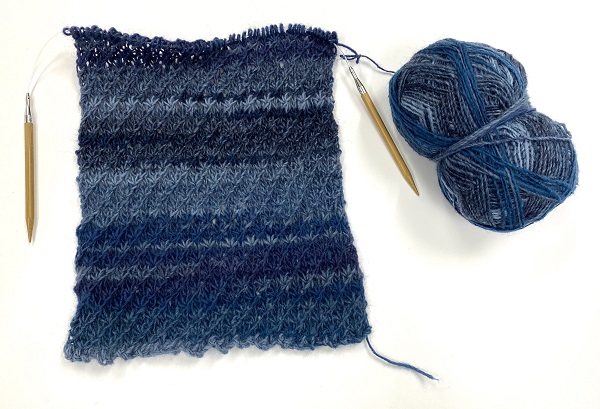

The same swatch above and below.
Single strand knitted on a 5.00mm yarn to achieve a beautiful scarf texture.
If you want to incorporate this into a sweater, it's better to use a 4.50mm yarn.
And for those who prefer slightly more structured sweaters, you can also use a 4.00mm yarn.


This is shown above in detail, and below is the same swatch.
Three strands knitted together on a 6.50mm yarn.
This gives you what most people want: a dense knit structure.
Personally, I'm not a fan of that. After all, we're not a chair, table, or cupboard, and we're made of soft materials.
One of muscle, the other of less muscle and more fat, but we are soft.
And so I still believe that a knit should be SOFT and supple to wear.
But but... who am I... So, I would personally call this a 7.00 to 8.00mm yarn with three strands together.
The most important thing is to show you that there is a really beautiful color fade and gradient in this entire collection.
Some colors are much less wild and stay within their color group.
Others are a bit wilder, and these flowerbed colors are the wildest.

